
A strong profile doesn’t automatically become a B-School Admission.
You know which b-schools you want: HBS, Stanford, Wharton, MIT, and other top programs in the US and Europe. What you can’t figure out is whether you look like every other qualified candidate in the pool or whether you’ll get in somewhere, just not where you know you belong.
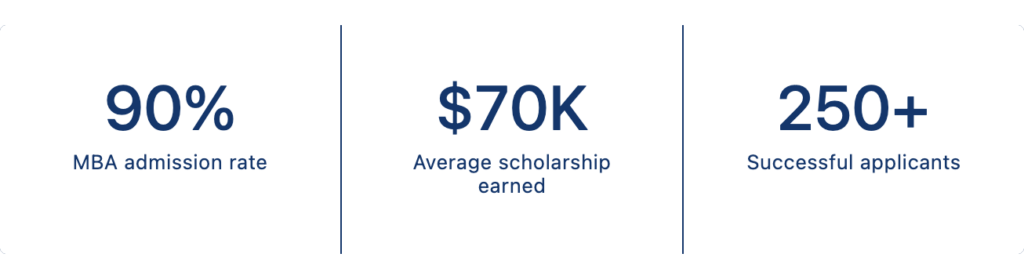
Admissions success at top programs:




You know you’re a strong candidate. What you can’t tell is whether your application shows that.
You’ve been purposeful with your career moves and built experiences that make you a strong business school candidate. You are ambitious and know that you want to be a leader with a career of impact, even if you are still discovering the right path for you. Yet somewhere in the back of your mind is a question you haven’t been able to answer: when someone reads your application, will they see what you see, or will you just be another qualified applicant who didn’t make the cut?
That gap between who you are and how your application reads is the part you can’t see from the inside. And for someone who is used to being able to figure things out, that’s an uncomfortable place to sit.
The right strategy depends on the future you’re building.
You know you want more from the next stage of your career. What’s often less clear is which path actually gets you there.
An MBA may be the right fit if you’re pursuing a career pivot, accelerated advancement, or broader leadership opportunities. An Executive MBA may make more sense if you want to keep growing within your organization while expanding your business perspective. A Deferred MBA is worth considering if your trajectory already points toward business leadership and you want to secure your options early. A PhD may be the stronger path if you’re drawn to research, academia, and building expertise within a field over the long term.
The question isn’t simply which degree to pursue; it’s what role that degree plays in the future you’re trying to create.
That gap doesn’t go away on its own.
You can put in the work, refine your essays, and still walk away with a rejection from a program you were qualified for. Not because you weren’t good enough, but because the application didn’t make it clear enough, to someone who has never met you, that you were exactly what they were looking for.
Two people with nearly identical backgrounds apply to the same program and get different answers. The difference is whether the application gave someone who has never met you enough to understand, clearly and quickly, why you belong there.
What that takes looks different depending on where you are and what you’re applying for.
Where are you applying?
Deferred MBA Admissions
Deferred programs aren’t designed for the candidate with a conventional path ahead. They’re designed for the one who is about to take a risk: the engineer who wants to found a company, the consultant who wants to spend two years working on the ground in a different country, the candidate whose most meaningful work doesn’t fit the traditional MBA mold. The difficulty is that you’re making that case without a professional record to back it up. Everything rests on whether the application can convince someone who has never met you that your past already points toward the future you’re describing and that the risk you’re about to take is exactly the kind of thing they built this program for.
MBA Admissions
Harvard admits around 8% of applicants. Stanford closer to 5%. Most M7 programs could fill their classes several times over with qualified candidates. The pool isn’t full of unqualified people; it’s full of people who look a lot like you on paper. The challenge is that the application has to make a case for you specifically, not just for someone with your background, your firm, or your industry. That has to be built deliberately, starting with a clear picture of what makes your candidacy distinct from everyone else who shares your profile.
Executive MBA Admissions
You’re not stepping away from your career to go back to school. You’re bringing the classroom into the work you’re already doing. That’s what makes the EMBA application uniquely difficult, as you can’t rely on potential. You have to show, with a career that’s already in motion, that what you’re building next is worth a seat. The application has to make clear not just the scope of what you’ve led, but the specificity of where you’re taking it. In a pool of accomplished professionals all making the same case, the ones who get in are the ones whose vision is the most concrete and the most compelling.
PhD Admissions
Most PhD programs admit single-digit applicants each year. The degree is fully funded, which means competition is intense and spots are genuinely scarce. But the harder challenge is that by the time you sit down to apply, you’re expected to have already identified your research thesis, connected with faculty who will supervise your work, and built a personal narrative that makes your entire path feel like it was always pointing here. Most applicants spend months on that groundwork with no way of knowing whether what they’ve built is specific enough to be taken seriously or too narrow to survive the process. Getting that wrong before the application starts means the application doesn’t matter.
Results at the Programs That Matter Most
The applicants we work with pursue some of the most competitive business school programs in the world, including MBA, Executive MBA, Deferred MBA, and PhD programs.
Over the past nine years, Sia Admissions clients have earned admission to Harvard, Stanford, Wharton, MIT, Kellogg, Booth, Columbia, Berkeley Haas, Yale SOM, Tuck, Ross, Fuqua, and other leading institutions.
Admissions decisions are made one candidate at a time. We focus less on formulas and more on understanding the specific strengths, risks, and opportunities within your profile.
What changed for our clients.

“Before working with the team, my story lacked clarity and strategic positioning. I had strong experience, but was not presenting a focused, compelling narrative. The three biggest improvements were clear career goals, sharper positioning of my experience, and structured, high-quality storytelling across my applications. The result was admission to all the programs I applied to.”
D.P.
Stanford MSx Candidate (admitted to Stanford, MIT Sloan, and Wharton)
“Watching my writing transform from the beginning of the process to the end was remarkable. The team helped me bridge the gap from merely having good anecdotes to articulating precisely why they were relevant to the program I was applying to.”
D.M
Wharton MBA Candidate (admitted to Wharton, Booth, Kellogg, and Columbia with $350,000 in cumulative scholarships)
“I started the process unconvinced that I was capable of getting into an M7. Their process pushed me miles beyond what I thought I was capable of, helping me identify themes and connections in my story that I was too close to notice myself. I ended with a scholarship to my dream school.”
S.B.
MIT Sloan Full-Time MBA Candidate (admitted to MIT Sloan, Berkeley Haas, LBS, and IESE — $100,000+ in scholarships)
Two ways to work with Sia Admissions.
Comprehensive Coaching
For applicants who want to leave nothing to chance.
Every decision in a competitive application carries weight, including the ones that don’t seem significant at the time. Comprehensive Coaching is built for the applicant who wants a partner at every step, someone to tell them what to do, when to do it, and how each piece is being positioned. Essays are reviewed as many times as they need to be; nothing is submitted until it’s ready. The process is rigorous by design because the cumulative effect of getting every detail right is what separates a strong application from one that gets in.
Strategic Advisory
For applicants who want to own the execution but not the strategy.
Some applicants are confident doing the work themselves. What they want is to make sure the strategic decisions shaping their application — how they’re positioning their candidacy, which schools make sense, how they’re framing their goals — are the right ones. Strategic Advisory covers every phase of the process at the strategy level. You build the plan together, then you execute autonomously. Along the way, you have access to biweekly sessions to work through questions as they come up, and one full application review at the point where it matters most.
Learn more about our other services
Not sure which fits? Start with a Profile Evaluation and we’ll talk through it from there.
Start with a Profile Evaluation.
The Profile Evaluation starts with a short form where you share your background, goals, target programs, and resume. Once submitted, you receive a written assessment from the Sia Admissions founder, containing a direct, honest read of what is working in your candidacy, what needs attention before you apply, and how competitive your profile is for the programs you’re targeting.
Sia Admissions works with MBA, Deferred MBA, Executive MBA, and PhD applicants. Availability is limited each round.
Frequently Asked Questions
A free service we provide, where you complete a short form with your background, goals, target programs, and resume. You receive a written assessment from the Sia Admissions founder covering what is working in your candidacy, what needs attention before you apply, and how competitive you are for your target programs.
No. Before we agree to work together, we assess whether we can genuinely help you, including whether your candidacy is viable, whether your target schools are realistic given your profile, whether you’re coachable, and whether you want this enough to do the work it requires. We work with twelve candidates per round per coach because the process is rigorous and that’s the number at which we can do it properly.
Applicants who come to us are typically strong candidates who cannot yet see their candidacy clearly from the outside. The application feels like the problem. In most cases, the foundation underneath it is.
Sia Admissions is a strategy-first boutique admissions coaching firm. That means the work begins long before an essay is written. We spend significant time understanding who you are, how you think, and where you are genuinely trying to go. Goals are developed and pressure-tested before school selection happens. School selection happens before positioning is finalized. Positioning is finalized before any material is touched. Each decision shapes the one that follows.
What that produces is an application where every component — the goals, the essays, the recommendations, the interviews — is telling the same story because it was built from the same foundation. That’s what our clients describe when they talk about what changed. The clarity about who they are and where they’re going is what has placed our clients into Harvard, Stanford, Wharton, MIT, INSEAD, LBS, and other top programs across the US and Europe.